
Design Articles
What is the lifespan of a logo?
It's great that you are taking the time to consider whether your logo and brand image needs to be updated. It is good to consider this from time-to-time, because you are correct that after a while, even great logos need updating. Thankfully the life of a logo tends to be much longer than the life of a website these days, so you won't need to reconsider your logo near as often as you website.
I had my logo designed many years ago, and lately I've been wondering whether I should have it redesigned. How long does a logo usually last before it needs to be redesigned?
It's great that you are taking the time to consider whether your logo and brand image needs to be updated. It is good to consider this from time-to-time, because you are correct that after a while, even great logos need updating. Thankfully the life of a logo tends to be much longer than the life of a website these days, so you won't need to reconsider your logo near as often as you website. As with all things branding and marketing, there is no hard and fast rule about the lifespan of a logo design. However, often you'll find that a good, professionally designed logo should last you about 10 years. Keep in mind that this is the guideline if you'd had your logo professionally designed. If you have more of a do-it-yourself logo design from when you were first starting out, you will probably want to consider having it redesigned as soon as you are making enough profit to make the investment. But before you get started, there are a few things to consider before redesigning your logo.
How much equity is in the logo?
Before redesigning your logo, you'll want to consider how much equity—or recognition—you have in your logo. If you redesign your logo, it will take your audience some time to get used to the new logo, and to recognize you by it. This means, you won't want to undergo a logo redesign on a whim. However, if your current logo is giving your audience the wrong impression, this readjustment can be just the shift that you need to help your audience to start seeing you in the light you wish to be seen in.
How extensive will the adoption process be?
Another thing to consider will be how tough it will be to remove instances of the old logo and replace them with the new logo. Things like business cards, stationery and packaging can be much more affordable than things such as signage. So you'll want to consider the extended cost of redesigning the logo. If a logo design would require more extensive changes, such as signage or office decor, you may wish to align your logo redesign with another company milestone, such as moving offices, renovating or reordering your packaging materials. This way, you can roll your logo changes into these other events, making the logo redesign feel like a natural progression alongside your other steps toward progress.
Do you really need a full redesign?
Another thing to consider is whether you really need a full redesign, or if you can do with more of a retouching or realignment. A logo retouch would mean that the concept of the logo stays in tact, but it is refined in some other way to polish and tighten it up. This might mean updating the color palette, the typeface, or simply reworking the existing composition to be tighter and more solid. For companies that feel they have a good amount of equity in their existing logo, this can be a good way to update without making too drastic of changes.
Tired trend: About pages
You're probably thinking I'm crazy. Did I really just assert that About pages are tired? Why yes I did. Don't think I'm crazy. I'm not suggesting that everyone has to ditch their About pages. What I am suggesting is that it is lazy site planning to simply include an About page by default.
You're probably thinking I'm crazy. Did I really just assert that About pages are tired? Why yes I did.
Don't think I'm crazy. I'm not suggesting that everyone has to ditch their About pages. What I am suggesting is that people have gotten to the point where they include an About page by default when they are planning the architecture of a website, and I believe that automatically adding an About page, without considering whether it is truly necessary to your site, is lazy site planning.
In a continued effort to promote simplicity, specifically simpler websites, I would suggest that you seriously consider whether you truly have things to say—that people actually want to hear—on your About page.
So often I see websites that include a summary of the company on the home page, and the exact same content (or nearly the same content) is repeated on a second, separate About page. If you don't have more to say—and remember, the qualifier here is that you need to have more to say that people really want to hear—then you just don't need a separate About page. If you have just a little more to say, there are other ways to solve that problem, such as a modal window or a callout on a complimentary page, that would offer the additional information for your audience to read, in a more appropriate format.
Next time you plan a site, stop and really consider what you need to say about your organization—and what people really want to know about it—before you add an automatic About page.
What is a brand; the sequel
We've written a previous post in an attempt to define branding using an illustration from Breakfast at Tiffany's, however we wanted to write a companion post in hopes to clarify branding a bit more.
We've written a previous post in an attempt to define branding using an illustration from Breakfast at Tiffany's, however we wanted to write a companion post in hopes to clarify branding a bit more.
Although we help people build their brands all day and all night, it is always tough to describe it when someone asks "what is a brand?" so we've been working on finding a better way to explain this infinitely important concept in a way that is simple and easy to understand. Here's what we've come up with: A brand is a perception.
In context of your organization, a brand is the perception a customer has of your company. Similarly, in context of yourself personally, a brand is the perception someone has of your character. There are two components of a brand: your internal brand and your external brand.
Internally, your brand is who you are at the core—it must be intentionally formed throughout your culture by continually upholding your established values.
Externally, your brand is the impression (or perception) that a customer or prospective customer has of your company.
Weak brands stem from an internal brand that is undefined, unremarkable, and maybe even just plain negative. Because their internal brand is so weak there is nothing to leverage into a memorable experience for their customers. Therefore their customers' perceptions of these companies are that they are vague, boring, or putting on a show (that they quickly see-through). This type of experience is off-putting for a customer and doesn't inspire customers to fall in love with your product or service.
Powerful brands find their strength in first building, strong, remarkable internal brands and then taking deliberate steps to demonstrate that brand throughout each touchpoint with a customer or prospective customer. By deliberately infusing their brand through every interaction—including their logo, website, marketing materials, office decor, customer service, etc.—these companies' customers experience a strong, consistent, memorable perception of what truly drives this organization. This type of experience is a delight for your customer and leaves them hungry for more of your product or service (and often willing to pay a premium for it).
Here at Strong Design, we work hard to further our clients brands. We do this by taking the time to learn about our clients' brands and designing each of their marketing pieces to help accurately shape a customer's perception of them and align the external perception of the company with the remarkable brand that lies within.
How to prepare for a business photo shoot
For many businesses, photography can be such an important part of putting your best foot forward. However, many people don't take proper considerations before taking their photos. Here are a few tips for how to prepare for a business photo shoot.
For many businesses, photography can be such an important part of putting your best foot forward. However, many people don't take proper considerations before taking their photos. Here are a few tips for how to prepare for a business photo shoot.
Professional photography makes a huge difference. I can't tell you how many times I've heard clients say "I have a nice camera, I can take my own photos." Unfortunately, what makes a great photo has very little to do with the equipment. What makes a fabulous photo is the consideration of composition, lighting, framing, angles and many other elements that take the skilled eye of an artist to capture.Although it is tempting to think you can do this step yourself, take a look at the comparison below to see the difference between a photo I took myself and one taken of the same subject by a professional photographer. The photo on the left was taken by myself with my high-res digital camera. The photo on the right was taken by local professional photographer, Wendy Martinez.
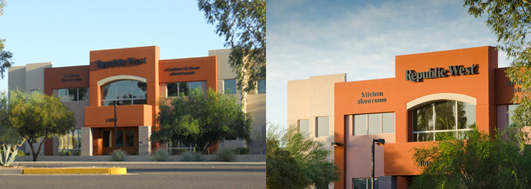
As a designer I have a good eye for layout, and you'd think I could take a decent photo, but when you compare my photo with a professional's photo, you can see how much more the professional photo captures the spirit of the subject and how it is technically much better in terms of composition, framing, lighting, etc.
“What makes a fabulous photo is the consideration of composition, lighting, framing, angles and many other elements that take the skilled eye of an artist to capture.”
Consider orientation
Although a photographer has the ability to take amazing photos, they can't possibly know where you intend to use them, so you'll want to have a discussion with them about the type of photos you need and where you intend to use them. When you are having this discussion, make sure you talk about whether you need your photos taken at vertical or horizontal orientation. You'll want to consider where you want to use your photos. For example, if you are looking to use your photos in the large main image area on your website, you'll definitely want to make sure you get lots of horizontal photos. However, if you are looking to use the images in more of a brochure-style context, vertical orientation might be what you need. If in doubt, make a point to ask the photographer to shoot each shot type at both orientations just to be safe.
Get close up—and far away
Likewise, you'll want to consider how closely zoomed the images should be. Lots of people—especially photographers—love zoomed-in photos because they are very artistic and intriguing. However, you need to consider how you'll be using the photos to know how close is appropriate. Let’s use the example again of a photo that would be showcased in a horizontal band on your website home page. This area isn't usually as tall as the images a photographer would take, which means you'd have to crop some of the image off the top and/or bottom of the image. If the image is zoomed in too far, the image could end up looking too abstract. It is important to consider issues like this and communicate them to your photographer before the photo shoot in order to get the most useful photos possible.
Make a list and check it twice
Although a professional photographer might be incredibly talented, they aren't a mind-reader. Make them a list of the different photos you need them to take. This is called a shot list. Doing this will help give the photographer good direction and will ensure that you get the images that you need for your marketing materials. Compiling a list helps you mentally catalog what photos you'll need and gives your photographer a roadmap of what images should be taken. If you forgo compiling a shot-list to guide your photographer, they may take that to mean that they should just take images of what they feel is interesting, which may produce disappointing results if these images are not the photos you need. A simple shot-list would look something like this:
Head-on view of the building front
3/4 view of the building front
Multiple angles of sign
Front desk with receptionist working
Front desk with receptionist posed and smiling
Candid action shots of your CEO working
Posed shot of your CEO at their desk
And so on...
Less is not more
If you know me at all, you know I'm a big fan of the adage, 'less is more.' However, when it comes to a photoshoot, less is not more. Make sure you plan an adequate amount of time for your photoshoot and request that the photographer takes lots of variations of the photos you need. You never know when an angle you never considered will be exactly what you need to make your business or product shine.
Keeping these items in mind will help make the most of your photoshoot and give you lots of flexibility for how you could use the images captured. If you're in need of a professional photographer and don't know who to call, feel free to reference this handy list of photographers I know and love.
What is the lifespan of a website?
Goodness knows websites have changed a lot site the first one launched back in the early 90s. The technology has grown immensely in the past 5 years, and even more rapidly in the most recent couple of years. Now more than ever, it is important to have a great website, as the web is most people's primary means to getting the information they need.
My site was designed several years ago, and now I'm wondering if I should have my site redesigned. What is the average lifespan of a website before it needs to be redone?
Goodness knows websites have changed a lot site the first one launched back in the early 90s. The technology has grown immensely in the past 5 years, and even more rapidly in the most recent couple of years. Now more than ever, it is important to have a great website, as the web is most people's primary means to getting the information they need.Back in the day, websites were created using a code structure called 'tables.' In the early 2000s, a new type of code structure emerged that used divs and CSS in place of the former tables. This era is often referred to as Web 2.0. Divs and CSS remain as the backbone of today's websites, but currently there are a host of additional types of technology, such as the WordPress CMS and Javascript that are used to make websites even more beautiful and useful to their owners.
But technology wasn't the only thing that changed.
Along with the advent of these new technologies, came new styles of design that weren't originally possible. A really basic example of this is standard site width. Back in the 90s, websites were no more than 800 pixels in width (and often narrower) because monitors where quite small and clunky browsers ate up a lot of screen real estate. Now, the current standard is 960 pixels in width, with a lot of websites bucking the standards and experimenting with sites even wider than that. These wider widths are made possible by the affordability of larger monitors.Another way times have changed is the increased amount of devices we access the websites from. It used to be that you sat down at your desktop computer to go online. Nowadays, you've got tons of options to choose from. Desktop and laptop monitors cover a range of sizes and then there are also the smaller sizes of tablets and mobile phones to consider. With all these screen sizes to consider, its no wonder that responsive web design has become widely adopted by modern browsers as a solution that enables the ability to adapt your site content to the device being used, and serve up a better user experience.
Now that you've got the background info, lets return to the question of how long a website should last.
The fact is that there is no set rule for how long a website should last. However, if you site is older than 5 years, there is a pretty high chance that it should be redesigned. If it is younger than that and was built really well from the beginning, you might be able to make it last a little bit longer by doing a bit of realignment, rather than a full redesign.However, you can only stretch a site so far before it just makes good sense to start fresh and rethink it given today's technology and user needs. When it comes to such a large piece of your marketing as your website, it is easy to fall into thinking that you've spend so much time and money on it, it must last a really long time. Unfortunately that just isn't the case.Design and technology are continuing to change at warp-speed, and it is more important than ever to offer your customers a great experience on your site. With the advent of everything being online, it has raised the bar for design excellence, and users make judgement calls about your product or service based on the experience of your website.If you haven't redesigned your site in the last 5 years, or if you created your site yourself when you were just starting out, you might want to determine where a redesign might fall into your marketing plan in the next year. And if you've recently redesigned your website, make sure to take time regularly to evaluate it, making sure the content stays up-to-date and that necessary course corrections are made. This will help to extend the longevity of the site.

Think we might be a good fit for you?
Let’s talk about how we can design your future.